

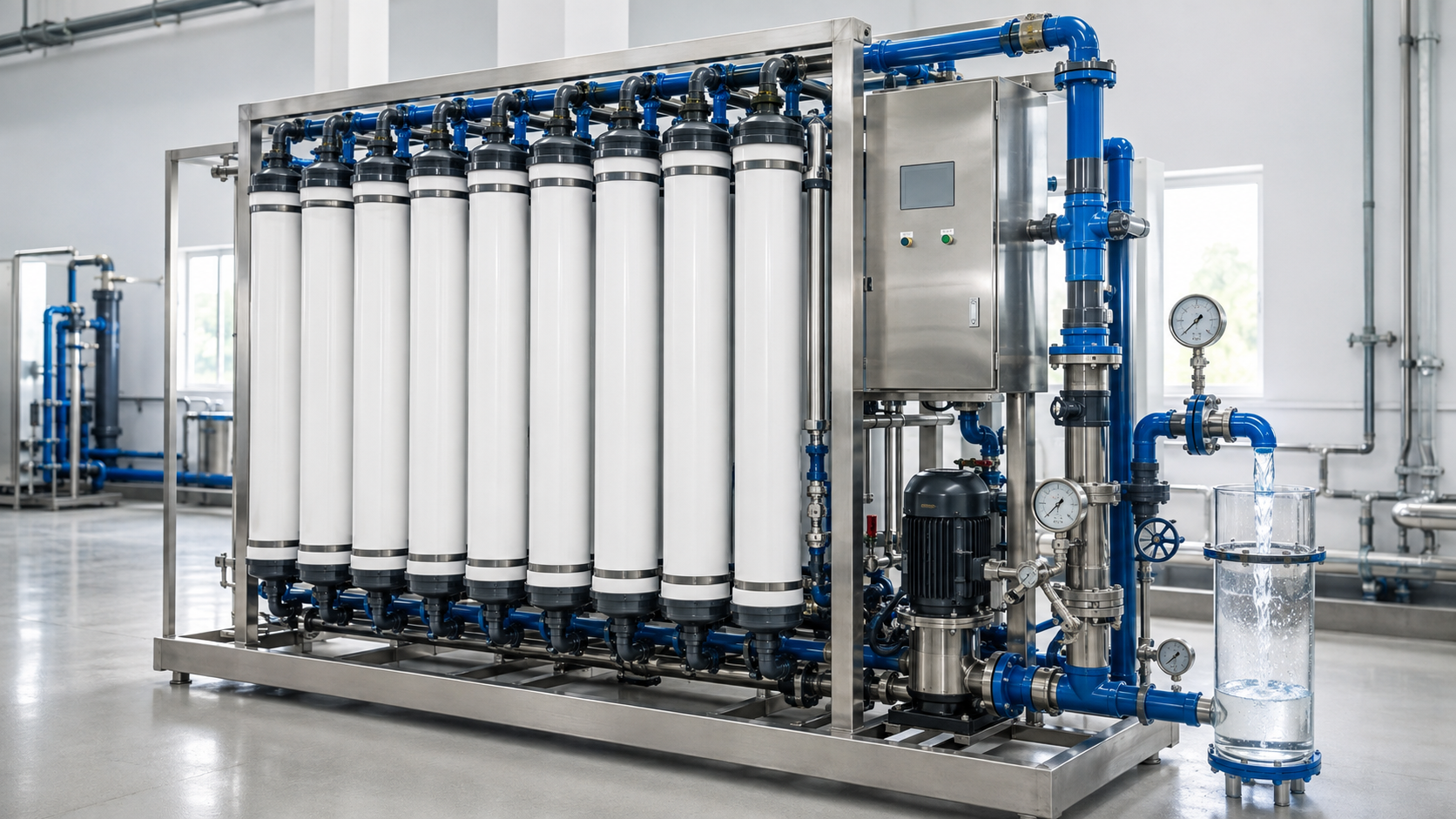
Choosing the right filtration technology requires understanding what needs to be removed from the water. A UF Ultrafiltration System can be useful when the treatment objective involves reducing suspended solids, turbidity, microorganisms, and fine particulate matter while retaining most dissolved salts.
For commercial and industrial users in Bangalore, UF is frequently evaluated as part of pretreatment, water recycling, or tertiary treatment systems.
UF Works Differently From Conventional Filters
Conventional media filtration captures particles within or across filter media. Ultrafiltration uses membranes with very small pores to create a physical separation barrier.
Water passes through the membrane while many larger contaminants are retained.
This can provide consistent filtration even when feed-water turbidity changes within the system's design limits.
When Should UF Be Considered?
UF may be suitable when facilities need:
- Improved removal of fine suspended matter
- Reduction in turbidity
- A membrane barrier for microorganisms
- Pretreatment before downstream membrane systems
- Polishing of appropriately treated wastewater
- Consistent filtered-water quality
Its suitability still depends on feed-water characteristics and the intended use of the treated water.
UF Is Not the Same as RO
This distinction matters during system selection.
UF primarily separates particles and larger contaminants. Most dissolved salts pass through the membrane.
RO, by comparison, is commonly selected when substantial reduction of dissolved salts is required.
If a facility's main problem is high total dissolved solids, installing UF alone will not solve that issue.
Consider Cleaning Requirements
Membranes accumulate retained contaminants over time.
UF systems therefore need suitable backwashing and, when required, chemical cleaning. Cleaning frequency depends on feed-water quality, operating flux, membrane type, pretreatment, and system configuration.
Facilities should understand these maintenance requirements before choosing the technology.
Evaluate the Complete Treatment Train
A membrane system rarely operates in isolation.
Depending on the application, upstream and downstream processes may include screening, clarification, media filtration, chemical dosing, disinfection, RO, or storage.
The goal should be to create a treatment train in which each stage protects and supports the next.
Questions to Ask Before Selection
Facility teams can evaluate UF more effectively by asking:
- What contaminants need to be removed?
- What is the feed-water turbidity?
- Is dissolved salt reduction required?
- What treated-water quality is expected?
- How much water is required daily?
- Where will the treated water be used?
- What cleaning and maintenance resources are available?
Daksha Greentech develops water treatment solutions for different commercial and industrial requirements in Bangalore, including systems where membrane filtration forms part of the overall process.
UF can be highly useful when selected for the right purpose. The decision should be based on water characteristics and treatment objectives rather than choosing membrane technology simply because it is considered advanced.