

Biological treatment is at the heart of many sewage treatment systems. Among the available technologies, the MBBR Moving Bed Biofilm Reactor uses specially designed carrier media to provide surface area where microorganisms can grow and help break down biodegradable contaminants.
Its relatively compact biological process makes MBBR relevant to many wastewater treatment applications.
What Happens Inside an MBBR Tank?
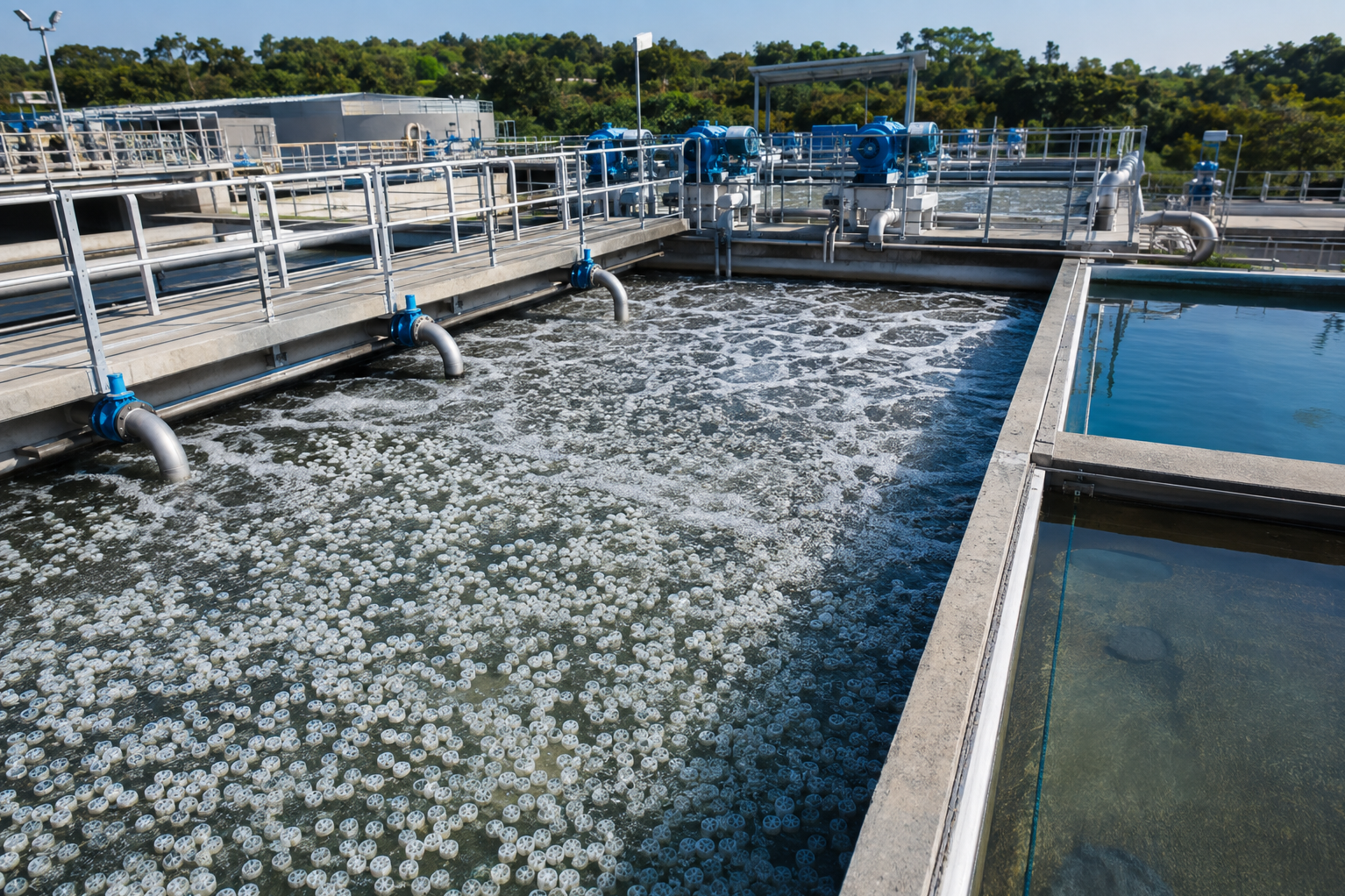
The reactor contains plastic carrier media that moves within the wastewater.
Microorganisms form a biofilm on the surface of these carriers. Aeration supplies oxygen and keeps the media moving, allowing the microorganisms to remain in contact with wastewater.
As wastewater passes through the biological stage, the microbial population helps degrade organic matter.
Why Carrier Media Matters
The carriers provide a large protected surface area for biological growth.
This allows a substantial microbial population to remain within the reactor without relying entirely on suspended biomass.
The amount and type of media should be selected according to treatment loading and reactor design rather than simply filling the tank with as much media as possible.
Potential Advantages
For suitable applications, MBBR can offer several practical benefits:
- Compact biological treatment
- High biofilm surface area
- Ability to handle variations within design limits
- No conventional sludge return requirement for maintaining attached biomass
- Potential integration into existing treatment systems
However, these benefits depend on correct engineering and operation.
Aeration Is Critical
The biological process requires adequate oxygen.
Insufficient aeration can reduce treatment efficiency, while poor air distribution may prevent proper carrier movement.
Blowers, diffusers, dissolved oxygen conditions, and reactor hydraulics therefore deserve careful attention.
Energy consumption should also be considered when evaluating lifecycle operating costs.
MBBR Still Requires Downstream Treatment
Biological treatment does not mean wastewater leaves the reactor ready for every reuse application.
Downstream clarification, filtration, and disinfection may be required depending on the desired treated-water quality.
Sludge produced during treatment must also be managed.
Is MBBR Suitable for Every Property?
Not automatically.
An apartment complex, hotel, hospital, institution, and industrial facility may have very different wastewater characteristics and operating patterns.
Before selecting MBBR for a Bangalore property, wastewater flow, organic loading, space availability, reuse objectives, and operator capabilities should be evaluated.
Daksha Greentech can assess these parameters while planning sewage and wastewater treatment systems for local facilities.
MBBR is best viewed as one biological treatment option within a complete treatment strategy. Its value comes from matching the process to wastewater characteristics and maintaining the conditions needed for stable biological activity.