

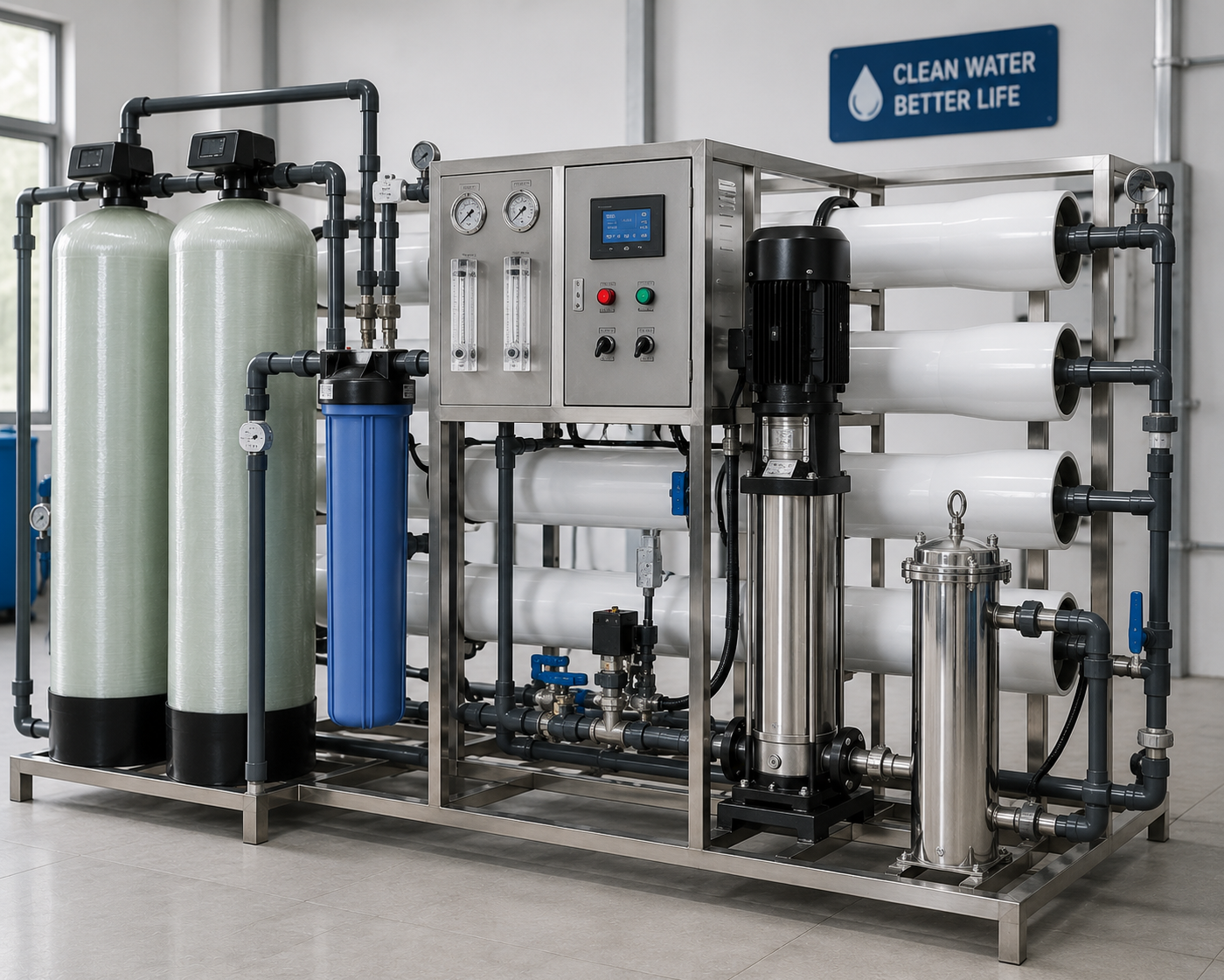
When water contains high levels of dissolved salts or other contaminants that conventional filtration cannot adequately address, an RO Plant may form an important part of the treatment system.
Reverse osmosis is widely used in commercial and industrial water treatment, but its effectiveness depends heavily on feed-water quality, pretreatment, membrane selection, recovery design, and regular maintenance.
How Reverse Osmosis Works
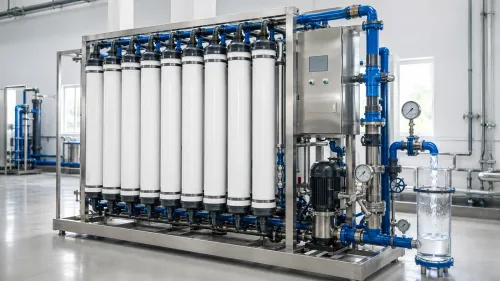
An RO system uses a semi-permeable membrane to separate water from many dissolved substances.
Pressure is applied to feed water, forcing a portion of it through the membrane. This produces treated permeate while a concentrated stream carries away rejected dissolved substances.
Because the membrane performs a much finer separation than conventional filtration, RO can be useful where dissolved solids need to be significantly reduced.
Pretreatment Protects the Membranes
RO membranes are sensitive components.
Suspended particles, hardness, chlorine, iron, organic contamination, and other substances can cause scaling, fouling, or membrane damage.
Depending on the feed-water analysis, pretreatment may include:
- Sand filtration
- Activated carbon filtration
- Softening
- Micron filtration
- Chemical dosing
- Other conditioning processes
Correct pretreatment can improve membrane life and help maintain consistent performance.
Recovery Rate Requires Careful Planning
Not all feed water becomes treated product water.
Part of the feed becomes reject or concentrate water. The proportion recovered depends on system design and feed-water characteristics.
Attempting to increase recovery without considering scaling potential can create operational problems. For this reason, recovery should be selected based on water chemistry rather than an arbitrary percentage.
Monitor Performance Over Time
Several indicators can help operators understand whether an RO system is performing normally.
These include:
- Feed pressure
- Differential pressure
- Product-water flow
- Reject-water flow
- Conductivity
- Salt rejection
- Recovery
- Chemical consumption
A gradual change in these parameters may indicate fouling, scaling, pretreatment problems, or membrane deterioration.
Where RO Systems Are Used
Organizations in Bangalore may use RO-treated water for selected industrial processes, boiler feed preparation, manufacturing, hospitality applications, laboratories, institutions, or other operations where reduced dissolved solids are required.
The exact application determines the treatment configuration.
Think Beyond the Membrane
A reliable RO installation is a complete treatment system rather than simply a membrane unit.
Daksha Greentech considers feed-water characteristics, pretreatment, capacity, required output quality, reject management, instrumentation, and maintenance requirements when developing water treatment solutions in Bangalore.
For users evaluating reverse osmosis, the starting point should always be water analysis. Once the feed quality and intended use are known, the plant can be designed around realistic treatment and operating requirements.