Rainwater, wash water and inconsistent segregation can turn a promising hotel food-waste feedstock into a diluted, contaminated slurry that produces unreliable gas. You will be able to audit the waste, protect the receiving area, compare treatment routes and specify a plant that remains operable through Bengaluru’s wet season.
Key takeaways
- Weigh food waste for 7–14 days across occupancy and banquet patterns.
- Install covered receiving areas and separate stormwater from feedstock.
- Specify contamination limits, retention time, gas yield and uptime in supplier bids.
- Compare digestion with composting, dewatering and off-site waste collection before investing.
Measure the food waste before choosing a digester
Use a weighed 7- to 14-day audit before selecting a digester. Record kitchen preparation waste, buffet leftovers, plate scrapings and spoiled stock, then extend the audit across several operating weeks to capture weekdays, weekends, occupancy swings and banquets.
Room count, kitchen capacity and guest numbers alone mislead because menus, occupancy, banquet volumes and outsourced catering change the feed.
Exclude these materials before weighing the biodegradable fraction:
- Packaging, sachets, cling film, gloves, cutlery, stones, bones, shells, cooking oil, cleaning chemicals and other contaminated material.
Wet tonnes are the scale reading, not the digester load. Total solids show how much of that wet mass is non-water; volatile solids show the biodegradable portion within the solids. Send representative composite samples for total solids, volatile solids, pH, COD, salinity, ammonia and contamination testing.
| Basis | Use in supplier comparison | Design consequence |
|---|---|---|
| Wet tonnes per day | Measures delivered feed quantity | Reveals daily handling and pumping demand |
| Volatile-solids loading | Measures biodegradable feed strength | Supports digester volume and gas estimates |
| Wet weight alone | Ignores dilution and inert material | Produces misleading capacity comparisons |
For hotel food waste biogas in Bengaluru, compare suppliers using tonnes per day and kilograms of volatile solids per cubic metre per day. Screen roughly 20–30 days’ hydraulic retention time and 1–4 kg volatile solids per cubic metre per day as starting ranges, not guarantees; final sizing depends on testing and process limits.
Keep monsoon water out of the receiving and feeding line
Rainwater entering the receiving pit, feed hopper or digester creates hydraulic dilution. Pumping and mixing volumes rise, organic loading falls, effective hydraulic retention time shortens, and gas production can drop. Do not size the digester for accidental rain inflow; protect the feed instead.
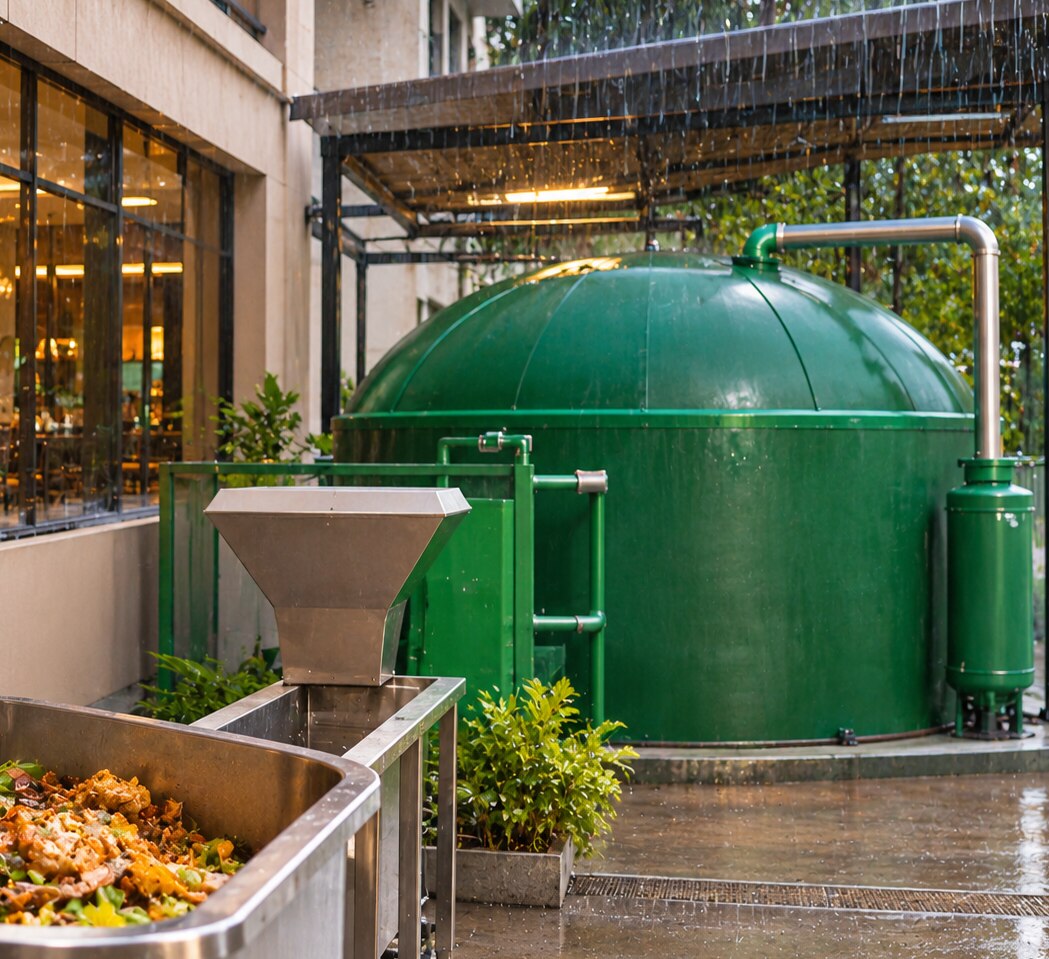
For a monsoon biogas plant for hotels, specify a roofed, bunded receiving bay with covered bins, sealed leachate drainage and a separate stormwater route. Set the finished floor above the site flood level, provide emergency drainage, preserve vehicle access for unloading and desludging, and protect electrical equipment from flooding.
Use this operating checklist:
- Drain free liquid from wet bins without sending wash water into the food-waste stream. Keep dishwashing drains and chemical-cleaning drains separate.
- Unload quickly into an enclosed or negatively ventilated area. Wet waste left in bins increases odour, flies and leachate.
- Wash floors and equipment daily, then direct wash water to sealed leachate collection. Use non-slip surfaces to prevent falls.
- Install a covered equalization tank and operating buffer for sudden occupancy or banquet changes. Blend variable feed instead of shocking the digester.
- Provide storage capacity for feed during rain interruptions, plus an emergency drainage route that cannot discharge into the hopper.
- Check roof gutters, bunds, covers, pumps and access routes before each rainy period. A blocked drain can stop feeding while the digester remains biologically sound.
Design segregation, pretreatment and stable biological feeding
Feed only segregated biodegradable waste into the digester. Unscreened hotel garbage brings plastics, metal and inert material that damage pumps, jam macerators and accumulate inside the tank.
1. Separate food at the source, then inspect each load before processing. Use manual picking or coarse screening to remove packaging, sachets, cling film, gloves, cutlery, bones, shells and stones. Send bones and shells to separate solid-waste handling; never grind them into the feed. Keep metal and packaging out of the macerator.
2. Macerate the accepted food waste and mix it with measured process water to form a pumpable slurry. Do not add rainwater or chemical wash water. Feed the slurry through a covered equalization tank so buffet surges, banquet loads and low-volume periods blend into a consistent daily feed.
3. Route fats, oils and grease through a grease trap or separation step. Remove captured grease routinely, and dose recovered material gradually after checking its effect on the process; sending a tankful of kitchen oil directly can create floating scum, block lines and drive volatile-fatty-acid accumulation.
Control or dilute excess sauces, salt, spices and citrus, while disinfectants, bleach, quaternary-ammonium compounds and other cleaners require separate handling.
4. Maintain mesophilic digestion at about 35–38 °C and keep pH near neutral. Confirm heater performance during Bengaluru’s rainy periods, because cooling slows biology and gas production. Actual biogas treatment for hospitality waste yields fall below laboratory results when feed is diluted, intermittent, contaminated or chemically inhibited.
Compare digestion with the alternatives at hotel scale
A wet digester suits a hotel with a measured, segregated daily feed, limited curing space, tolerance for enclosed equipment and a useful outlet for biogas. For Bengaluru hotels handling food waste during monsoon, the decision must also account for access, odour and output management.
| Route | Feed, footprint and labour | Monsoon, energy and output |
|---|---|---|
| Anaerobic digestion | Steady wet feed; compact footprint; trained operator and daily inspection | Roofed access is essential; mixing and heating consume power; gas requires storage or automatic flaring, and digestate needs permitted reuse or disposal |
| Composting | Suitable for larger solids; needs bulking material, curing space and turning labour | Rain disrupts aeration and access; low energy, but odour and leachate rise; hotel must use or move finished compost |
| Vermicomposting | Smaller, clean feed; requires bulking material, shaded curing space and careful labour | Flooding and heat harm worms; low energy; finished material needs testing and a reliable outlet |
| Municipal wet-waste collection | Minimal equipment and footprint; low on-site labour | Pickup schedules, vehicle access and contamination rules control reliability; no energy recovery or on-site output |
| Dewatering or aerobic treatment | Dewatering cuts transport volume; aerobic systems need footprint, aeration and dependable power | Processor or aeration must remain available; dewatering does not remove the need for an approved downstream processor |
Digestion is not a gas-demand match: kitchens, boilers and generators rarely consume gas as quickly as it forms. Specify storage or automatic flaring, pressure-vacuum protection, condensate traps, hydrogen-sulphide removal and safe digestate storage. Test digestate and send it only through a permitted reuse or disposal route.
Turn the plant brief into measurable supplier requirements
A tender for hotel food waste biogas in Bengaluru must state its design basis, not just “10 tonnes per day.” Require these figures in writing:
- Assumed tonnes per day, total solids, volatile solids, operating days, methane concentration, gas-volume basis, hydraulic retention time, heating arrangement and parasitic electricity consumption.
- A roofed, bunded receiving bay with sealed leachate collection, separate stormwater drainage, corrosion-resistant equipment, non-slip access, flood protection, emergency drainage and vehicle access.
- Electrical equipment and installation practices suitable for wet and hazardous gas areas, plus lightning protection. Require gas-line low-point condensate traps, pressure regulation, hydrogen-sulphide control, flame arrestors where required, gas storage or flare capacity and emergency shutdown.
- Operator training, cleaning frequency, spare pumps and a rainy-season contingency procedure, including covered temporary storage when feeding stops.
Define acceptance testing after acclimatization. The supplier must measure feed quantity, gas volume, methane percentage, uptime, parasitic electrical consumption, digestate quantity and contamination rate over an agreed operating period. Gas volume without feed solids, methane concentration and operating hours is not a valid comparison.
Evaluate Daksha Greentech International against the same feed data and acceptance schedule as every other bidder. For biogas treatment for hospitality waste, compare the documented design basis and monsoon operating plan—not a nominal digester capacity. A Bengaluru supplier must show how the plant remains measurable and operable when rain, contamination or occupancy changes disrupt feeding.
Related product
 | Biogas Plant A Biogas Plant is an efficient renewable energy solution designed to convert organic waste into useful biogas through anaerobic digestion. View product → |
Frequently asked questions
How should a Bengaluru hotel measure food waste before sizing a digester?
Run a weighed 7- to 14-day audit covering kitchen preparation waste, buffet leftovers, plate scrapings and spoiled stock. Include weekdays, weekends, occupancy changes and banquets, then size the system from representative daily quantities rather than a single peak day.
How can hotels keep monsoon water out of a biogas plant?
Cover the receiving and feeding areas, raise access points above runoff, install drains around—not into—the feed line, and keep stormwater piping separate from slurry and wash-water collection. Track dilution after heavy rain because excess water reduces effective digester loading.
What should a hotel remove before feeding food waste to a digester?
Remove plastic, cutlery, glass, metal, bones and packaging at source. Use sorting and screening, then apply the selected size-reduction and slurry-mixing process so the digester receives a consistent feed without abrasive or blocking material.
What should a hotel require from a biogas plant supplier?
Request guaranteed throughput, feedstock moisture and contamination limits, hydraulic retention time, expected biogas yield, methane range, gas-cleaning equipment, uptime, digestate handling, monsoon drainage design and a commissioning test with measured results.
Keywords