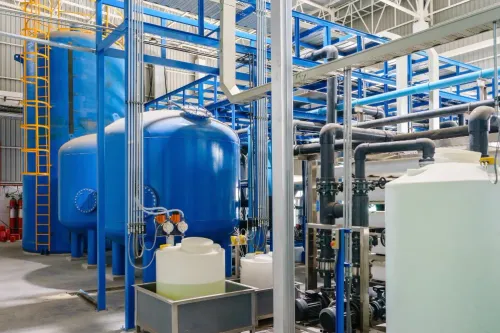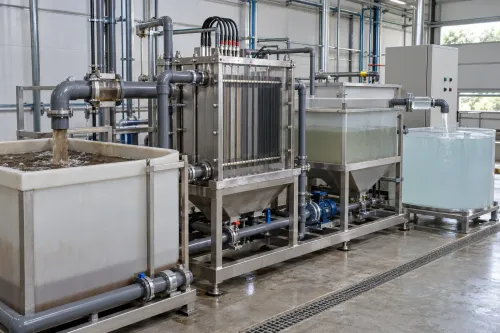
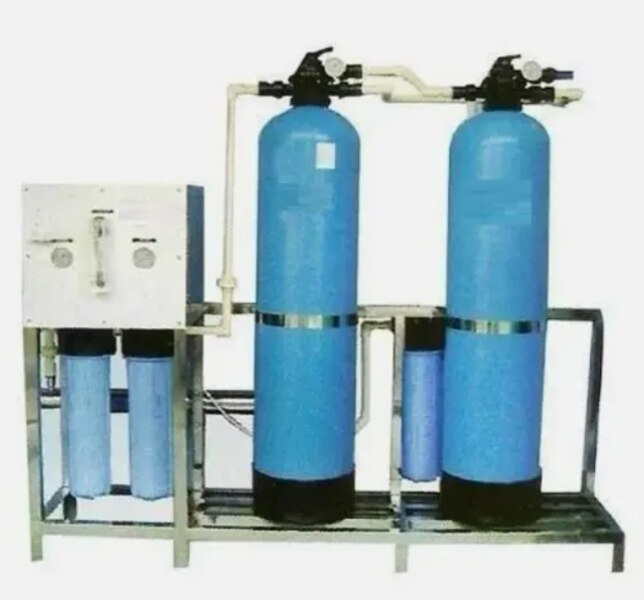
Scale on geyser elements, boilers, heat exchangers, laundry equipment and hot-water lines can increase maintenance and reduce heating performance, but hardness is only one part of the water-quality problem. You will be able to identify whether softening is appropriate, test the actual Bengaluru source, estimate plant capacity and compare supplier proposals against operating requirements.
Key takeaways
- Test hardness at the actual borewell, tanker or municipal inlet before selecting equipment.
- Use softening for hardness; choose filtration, RO or scale control for different contaminants.
- Size capacity from flow, hardness, regeneration frequency and resin exchange capacity.
- Compare salt, water, power, resin and service costs—not only the purchase price.
Where hard water creates commercial-property problems in Bengaluru
Scale is a daily operating problem when hard water is heated. Calcium-carbonate deposits coat geyser elements, restrict hot-water lines, reduce heat-transfer efficiency and force more frequent cleaning. The commercial water softener benefits are greatest where hardness is high, water is hot and equipment runs for long hours.
The highest-payback targets are:
- Geysers, boilers and hot-water generators, where scale increases heating time and energy use.
- Heat exchangers, where a thin deposit reduces heat transfer.
- Dishwashers and laundry equipment, where scale affects heaters, spray arms, valves and wash quality.
- Cooling-related equipment and circulation lines, where deposits reduce flow and heat rejection.
- Plumbing fixtures, taps and showerheads, where blocked outlets create maintenance calls.
- Hot-water storage tanks and return lines, where deposits narrow passages and reduce available flow.
A softener prevents new calcium and magnesium scale; it does not remove deposits already fixed to an element, pipe or heat exchanger. Descale those assets separately before commissioning.
A site that uses BWSSB supply, borewell water, tanker water or a blended source must test the actual inlet and point of use because hardness and fouling risks can differ sharply.
Request a laboratory result for hardness as mg/L as CaCO3 before sizing a water softening plant for benefits in Bengaluru, and check iron, suspended solids and alkalinity so pretreatment does not get overlooked.
Test the actual source before choosing a softener
A laboratory hardness result confirms whether calcium and magnesium are driving the scale. Collect a raw-water sample at the incoming source and another at the equipment inlet, then request hardness in mg/L as CaCO3. Include calcium, magnesium, alkalinity, pH, TDS, iron, silica and suspended solids; TDS alone cannot diagnose hardness.
Below 60 mg/L is soft, 61–120 moderately hard, 121–180 hard and above 180 very hard.
| Source | Where to sample | What to check |
|---|---|---|
| BWSSB supply | Incoming line before storage, then a point of use | Seasonal or building-storage changes |
| Borewell | Borewell discharge before treatment | Hardness, iron, alkalinity and silica |
| Tanker water | Each tanker source or delivery batch | Source variation and suspended solids |
| Blended water | The final mixed line during normal operation | Actual proportions and peak-demand quality |
Test each source separately before blending them in your design. If borewell and BWSSB water enter the same tank, sample the mixed outlet during occupancy; a softener sized from one source can leak hardness when another dominates. Repeat testing after a source change or abnormal scale event.
Specify the intended use too. Sodium-cycle softening adds about 0.46 mg/L sodium for each 1 mg/L hardness removed as CaCO3, so drinking, food preparation and medical uses may need a separate low-sodium or RO line. Use the laboratory report and peak demand to select a water softening plant in Bengaluru.
Choose between softening, filtration, RO and chemical scale control
A softener targets hardness, not every water-quality problem. Its commercial water softener benefits include protecting hot-water generators, heat exchangers, laundry machines, dishwashers and fixtures from new calcium-carbonate scale.
| Option | What it addresses | When it applies |
|---|---|---|
| Softener | Calcium and magnesium hardness; does not remove TDS, silica, pathogens or existing scale | Use for scale-forming hardness in equipment water |
| Filtration | Suspended solids, turbidity and, with suitable media, iron or manganese | Add before a softener when solids or metals could foul resin and valves |
| RO | Dissolved salts, chloride, sulfate, TDS and some silica; it is not a complete disinfection barrier | Use for low-salt water, process water or potable lines that need salt reduction |
| Chemical scale control | Scale risk through dosing, conditioning or threshold inhibition; it does not remove hardness | Consider for cooling systems or applications where softening is impractical |
Choose more than a softener when testing finds high turbidity, iron, manganese, oil, organic fouling, silica or high TDS. Pathogen control requires a validated barrier such as ultraviolet treatment, chlorination or membrane treatment; softening does not disinfect.
Sodium-cycle softening also raises sodium by about 0.46 mg/L for each 1 mg/L of hardness removed as CaCO3. Keep drinking, food-preparation and medical water on a separately assessed line when sodium or dissolved-salt limits matter. Chemical dosing does not replace filtration where solids are present.
Understand the softener cycle and calculate the required capacity
An industrial water softening system passes raw water through cation-exchange resin. During service, the resin captures calcium and magnesium and releases sodium or potassium. This reduces scale-forming hardness, not chloride, sulfate, silica, pathogens or TDS. After exhaustion, the valve backwashes the bed, applies brine, rinses away displaced hardness and returns the unit to service.
- Size the service flow for peak simultaneous demand, such as showers, laundry, kitchens and hot-water generation running together; average daily consumption alone can cause hardness breakthrough.
- Calculate hardness load as: daily water volume in m³ × hardness in mg/L as CaCO3 ÷ 1,000 = kilograms of hardness per day.
- Divide the hardness load between regenerations by the resin’s stated usable capacity, not its theoretical capacity. Add a reserve so the bed does not exhaust during occupancy peaks.
- Set regeneration frequency from operating hours, daily load, salt dose, regeneration-water volume and the available recovery window. Confirm the drain can accept the regeneration discharge.
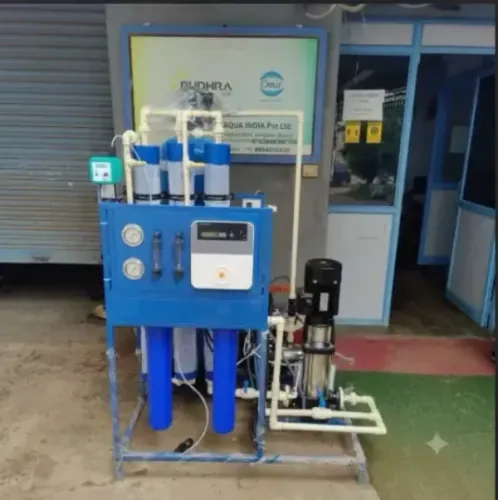
- Require the design to state resin quantity and type, rated flow, allowable pressure drop, guaranteed inlet and outlet hardness, automated valve sequence, bypass arrangement, operating spares and commissioning water test.
A supplier should show that the selected resin volume handles peak flow without excessive pressure loss and completes regeneration before the next demand period. A larger tank is not automatically better: it can waste salt and water if the operating load does not justify it.
Compare Bengaluru softener proposals by performance and operating cost
Approve a water softening plant in Bengaluru only against guaranteed results, not tank size or a quoted litres-per-hour figure. Give every bidder the same recent laboratory report from the actual source and point of use, plus the building’s peak demand.
| Proposal item | Require in writing | Why it matters |
|---|---|---|
| Inlet and outlet | Hardness in mg/L as CaCO₃, rated service flow and pressure-drop limit | Confirms treatment performance under load |
| Resin and regeneration | Resin type and quantity, salt dose, regeneration-water volume and cycle duration | Reveals salt and water consumption |
| Controls and hydraulics | Automatic valve sequence, bypass arrangement, drain size and backwash flow | Prevents interrupted service and drainage failures |
| Commissioning | Raw and softened-water test results, signed at startup | Proves the plant meets its guarantee |
Compare annual operating cost using salt, regeneration water, electricity, consumable prefilters, resin replacement and planned service visits. Ask for the operating-spares list, including injector parts, seals, brine components and valve controllers; an inexpensive quote becomes costly when these items are unavailable.
Check pretreatment before approving the softener. Turbidity, suspended solids, iron, manganese, oil or organic fouling can damage resin and valves, requiring multimedia, cartridge or iron-removal treatment.
Require the supplier to calculate sodium addition: each 1 mg/L of hardness removed as CaCO₃ adds about 0.46 mg/L sodium. If softened water serves drinking, food preparation or medical use, request a separate low-sodium or RO line. Daksha Greentech International should address that separation when designing the proposal.
Related product
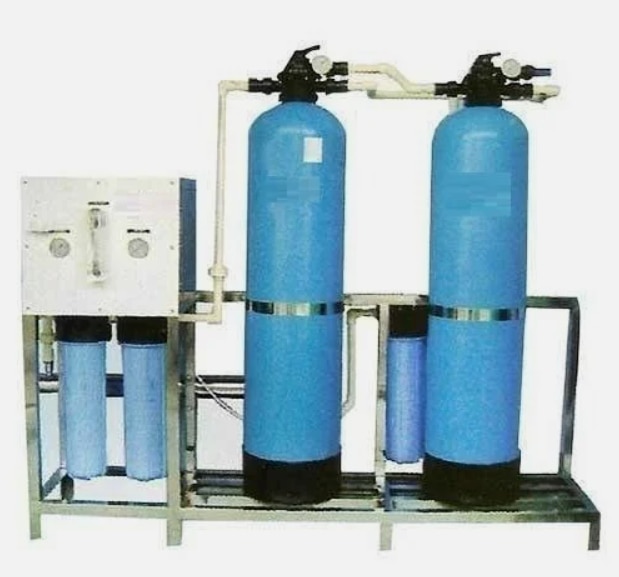 | Water Softening Plant DAKSHA GREENTECH INTERNATIONAL offers high-performance Water Softening Plants designed to reduce hardness-causing minerals such as calcium and... View product → |
Frequently asked questions
Where does hard water create problems in Bengaluru commercial properties?
Heated hard water forms calcium-carbonate scale on geyser elements, boilers, hot-water lines, heat exchangers, dishwashers and cooling equipment. Deposits restrict flow, increase cleaning work and reduce heat-transfer performance.
What should you test before choosing a commercial water softener?
Test the actual source entering the property, such as borewell, tanker or municipal water. Record total hardness as calcium carbonate, pH, iron, turbidity, TDS, flow rate and daily water demand, then test again if the source changes.
When should you choose softening, filtration, RO or chemical scale control?
Choose softening when calcium and magnesium hardness cause scale. Choose filtration for suspended solids, activated carbon for chlorine and some organic compounds, RO for dissolved salts, and chemical scale control when a compatible dosing programme suits the equipment and discharge conditions.
How do you compare water-softener proposals in Bengaluru?
Compare treated-flow rate, inlet hardness, resin volume, exchange capacity, regeneration trigger, salt dose, rinse-water volume, valve controls, bypass arrangement, resin replacement plan and annual operating cost. Ask suppliers to state these figures in the quotation.
Keywords