A commercial property does not automatically need an industrial effluent treatment plant: toilets, wash basins and staff facilities usually produce domestic sewage for an STP, while process chemicals, oils, metals or concentrated wash water call for an ETP. By checking each wastewater source, testing representative samples and comparing treatment, compliance and lifecycle costs, you can specify a plant that fits the building rather than overbuying unsuitable equipment.
Key takeaways
- Separate process effluent from domestic sewage before selecting an ETP.
- Collect flow measurements, pH, COD, BOD, TSS, oil and grease data.
- Match treatment stages to contaminants, discharge limits and reuse goals.
- Compare lifecycle cost, guarantees, instrumentation, sludge handling and operator support.
Does the building produce industrial effluent or domestic sewage?
A large commercial property does not automatically need an industrial plant. Toilets, wash basins, staff facilities, housekeeping and ordinary kitchen wastewater normally belong in an STP; a commercial building ETP is justified by a distinct process stream.
1. Map every drain before selecting a plant. Mark toilets, kitchens, laundry rooms, laboratories, vehicle-washing bays, food-processing areas, metal-finishing operations, chemical stores, cooling-tower blowdown, parking drains and generator areas. A drain carrying only domestic wastewater is not industrial because the building is large.
2. Identify activities that change the treatment requirement. Malls with food courts, hospitals, hotels, laundries, laboratories, vehicle service areas, data centres and buildings with manufacturing or process tenants may generate effluent requiring an ETP. Laundry liquor, laboratory discharge, vehicle-washing water, food-processing wastewater, metal-finishing rinse water and chemical waste need separate assessment.
3. Choose one STP, one ETP, or separate systems based on the mapped streams. Keep process wastewater away from sewage when it is toxic, saline, oily or high-strength; these characteristics can inhibit biological treatment, damage equipment and make compliance testing difficult.
An industrial effluent treatment plant in Bengaluru therefore requires site-specific sampling, not a label based on property size.
Send each process stream for testing before combining it with sewage. Record its flow, pH, COD, TDS or conductivity, oil and grease, metals and suspected chemicals; COD alone cannot prove that biological treatment will work.
What survey and laboratory data should you collect before design?
An industrial effluent treatment plant in Bengaluru needs measured loads, not a tank selected from floor area. Before requesting a design, record the building’s actual wastewater sources and operating pattern.
1. Survey each tenant and process. Note tenant activities, operating hours, average daily flow in KLD, peak hourly flow, wash-water volumes, chemical use, separate drains, weekend occupancy, food-court surges, cleaning cycles and future tenant loads. Record kitchen, laundry, laboratory, vehicle-wash and other process streams separately from toilets and wash basins.
2. Measure both average and peak hydraulics. A plant sized only for daily average flow can overflow or lose treatment performance during lunch, laundry, vehicle-wash or cleaning peaks. Log flow by hour across normal weekdays, weekends and high-occupancy periods; include batch discharges and planned expansion when setting equalisation and treatment capacity.
3. Take representative composite samples across those operating periods, not one grab sample from a mixed drain.
Test each important stream and the combined inlet for pH, BOD, COD, TSS, oil and grease, TDS or conductivity, ammonia, total nitrogen, phosphates, chlorides, sulphates, heavy metals, colour, temperature and relevant microbiological indicators such as total coliform and E. coli where reuse is planned.
COD alone cannot establish biodegradability or toxicity: two effluents with identical COD can contain different biodegradable fractions, inhibitors or toxic compounds. Ask the laboratory to identify unusual chemicals, solvents, disinfectants and cleaning agents, then give the designer concentrations, sampling times and flow-linked loads rather than test results without context.
Which treatment process fits the building’s wastewater?
Choose the treatment train from pollutants, peak loading and the intended outlet—not from a generic packaged commercial building ETP.
| Process | Purpose | When it applies |
|---|---|---|
| Screening | Removes rags and solids | Every influent stream |
| Equalisation | A mixed, level-controlled buffer that reduces variation in pH, concentration and hydraulic loading | Size it for the facility’s peak production pattern, not average daily flow; provide mixing or aeration and level control |
| pH correction | Brings acidic or alkaline wastewater into a treatable range | Extreme pH or chemical process discharge |
| Oil separation | Removes free oil and grease | Vehicle washing, workshops and oily process water |
| Coagulation-flocculation | Converts fine or dissolved pollutants into settleable flocs | Metals, colour, phosphorus, emulsified oil or poorly biodegradable compounds |
| Primary clarification | Settles chemical and suspended solids | After coagulation-flocculation |
| Biological treatment | Reduces biodegradable BOD and COD | Domestic-strength or biodegradable organic wastewater; MBBR and SBR alone do not reliably remove dissolved metals or high TDS |
| Tertiary filtration | Polishes suspended solids | Non-potable reuse or a specified discharge limit |
| Disinfection | Controls pathogens | Reuse or discharge requiring microbial control |
| Sludge handling | Dewatering, storage and authorised disposal | Every chemical and biological train |
Kitchens and food courts need a grease interceptor before biological treatment, plus a cleaning and waste-disposal schedule. Select filtration and disinfection for suitable non-potable reuse; high-TDS water needs RO or another advanced process and a documented plan for its reject concentrate.
Chemical treatment is essential when metals, extreme pH, emulsified oil, colour, phosphorus or poorly biodegradable compounds would upset biology.
What compliance and operating provisions belong in the project?
Confirm the site’s Consent for Establishment and Consent for Operation with the Karnataka State Pollution Control Board before approving the plant. Verify the authorised discharge point, reuse conditions, sampling frequency and method, and any industry-specific limits. A supplier’s catalogue outlet values do not constitute project approval.
For internal reuse, separate potable and recycled-water plumbing so a cross-connection cannot contaminate drinking water. Provide treated-water storage, continuous or scheduled disinfection, and a bypass or contingency route that holds off-specification water instead of sending it to users.
Include sludge in the ETP scope. Identify expected wet and dry quantities, select a filter press, centrifuge or other dewatering unit, define polymer consumption, and provide covered temporary storage. Keep weighing, transport and manifest records, then send sludge to an authorised disposal or reuse facility after characterisation.
Sludge containing metals or hazardous constituents needs a separate handling route and must not enter general municipal waste.
Before signing off, confirm:
- Safe operator access to tanks, pumps, valves, instruments and sampling points.
- Online or routine monitoring for pH, flow and other consent parameters.
- Bunded, labelled chemical storage with spill-control provisions.
- Odour control at screening, equalisation and sludge areas.
- Connected electrical load, panel capacity, earthing and standby power.
- Standby pumps, blowers and critical dosing equipment.
- Isolation valves, lifting space, drain-down points and maintenance clearance.
How should you compare supplier proposals and industrial ETP cost?
Compare the industrial effluent treatment plant cost only after suppliers price the same flow, pollutant load, outlet limits and operating hours. Tank volume and motor horsepower alone do not prove equal treatment performance.
| Option | Preliminary Bengaluru screening range | What the price excludes |
|---|---|---|
| Packaged 10–25 KLD ETP | ₹8–20 lakh | Major civil works, long pipe runs, RO or ZLD, land, GST and recurring sludge costs |
| 50–100 KLD conventional physico-chemical plus biological plant | ₹20–75 lakh | The same exclusions; confirm chemical systems, automation and tertiary treatment |
| Metal removal, high-TDS treatment or ZLD | Can exceed these ranges substantially | Price the specialist process, reject handling and sludge disposal separately |
These are budgeting ranges, not quotations. Civil loads, equalisation volume, electrical capacity, odour control, site access, laboratory equipment and hazardous-waste handling can change the industrial ETP cost sharply.
Ask an industrial ETP supplier in Bengaluru to submit:
- Process-flow diagram and mass balance
- Equipment datasheets, inlet assumptions, outlet limits, flow and temperature basis
- Power, chemical and sludge-quantity estimates
- Civil-load data, commissioning plan, operator training and O&M schedule
Require guarantees stated as inlet and outlet concentrations or mass loads. “90% removal” means little without an inlet limit, because dilution and changing loads alter the outlet result. Compare filtration and disinfection with RO only against the intended reuse route; RO also needs a reject-management plan.
Daksha Greentech International belongs in the comparison when its proposal documents these assumptions clearly, as should any ETP manufacturer near Bengaluru.
Related products
 | Industrial Effluent Treatment Plant Industrial Effluent Treatment Plant DAKSHA GREENTECH INTERNATIONAL is a trusted Manufacturer and Supplier of Industrial Effluent Treatment Plants, designed to provide efficient,... View product → |
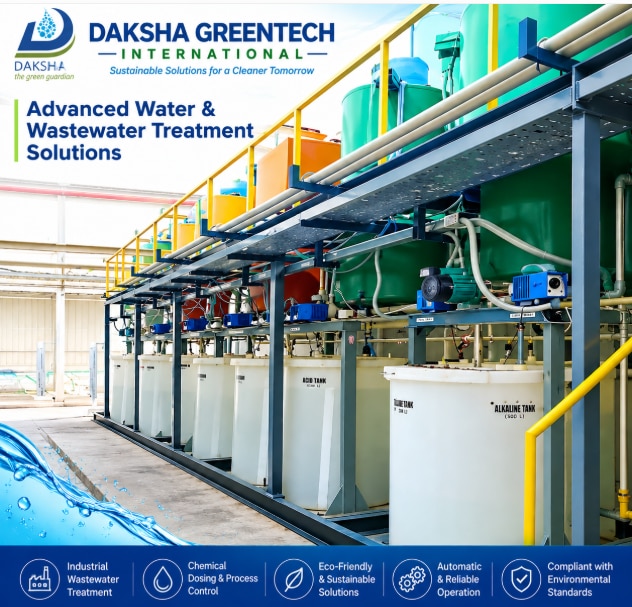 | Effluent Treatment Plant The Effluent Treatment Plant (ETP) is an advanced wastewater treatment solution designed to treat industrial effluents and reduce unwanted... View product → |
Frequently asked questions
Does a commercial building need an industrial effluent treatment plant or an STP?
Use an STP for toilets, wash basins, housekeeping and ordinary kitchen wastewater. Choose a commercial building ETP when a distinct process stream contains contaminants such as chemicals, oils, metals, solvents or high-strength organic waste.
What survey and laboratory data are needed before designing a commercial building ETP?
Collect source-wise flow measurements, operating hours, peak flow, process descriptions and cleaning chemicals. Test representative samples for pH, BOD, COD, TSS, oil and grease, conductivity, colour, temperature and any industry-specific contaminants.
Which treatment process fits industrial effluent from a commercial building?
Select treatment from the contaminant profile and discharge or reuse target. A typical design may combine screening, equalisation, pH correction, oil separation, biological treatment, clarification, filtration and disinfection; metals, solvents or high dissolved solids require additional treatment.
What compliance and operating provisions should an industrial ETP project include?
Define inlet and outlet quality guarantees, sampling points, flow measurement, chemical storage, sludge dewatering, bypass prevention, safety controls, operator access and disposal records. Confirm consent conditions and discharge limits with the Karnataka State Pollution Control Board.
How should you compare industrial effluent treatment plant cost and supplier proposals?
Compare installed scope, civil works, electrical load, automation, chemicals, sludge disposal, testing, warranties, spares and operator training. Request a process basis, equipment schedule, guaranteed outlet values and five-year operating-cost estimate from each supplier.
Keywords