Choosing capacity from the building’s water connection alone can produce an overloaded plant, poor treated-water quality, and avoidable operating costs. By the end, you will be able to calculate a defensible design flow, compare MBBR, SBR, MBR, and activated-sludge systems, and specify the site, reuse, service, and compliance requirements before requesting quotations.
Key takeaways
- Size capacity from measured wastewater flow, not connected water supply.
- Choose MBBR, SBR, MBR or activated sludge by reuse quality and staffing.
- Separate sewage flows from kitchens, laboratories and rainwater before sizing.
- Specify testing, operator duties, spares, response times and sludge removal in the contract.
How to calculate the right STP capacity for a Bengaluru building
Size the STP from measured wastewater, not the building’s connected water-supply figure. For packaged sewage treatment plant for options in bengaluru, capacity is the first comparison point: decide whether 10 KLD, 25 KLD, or a larger unit matches actual flow.
1. Take the water meter total for a representative month and calculate the daily average. Start with sewage at 80% of water use, then add cleaning water, kitchen demand, infiltration, future occupancy, visitors, toilet usage, and working hours.
2. For 30,000 litres per day of metered consumption, the starting sewage estimate is 24,000 litres per day. Cleaning, kitchen use, infiltration, occupancy growth, and visitor peaks can push the design basis beyond 25,000 litres per day, making a 25 KLD plant more defensible than a 10 KLD unit.
3. Ask every supplier to state average-day, peak-day, and peak-hour flow separately. Require the equalisation-tank volume and the plant’s hydraulic peak-handling rate; a unit sized only for the daily average can overflow during lunch, closing, or event periods.
4. Use different assumptions for each building: offices have weekday peaks and weekends near zero; malls have visitor-driven toilet surges; hotels have continuous occupancy, laundry, and kitchen loads; institutions follow class, ward, or shift schedules. Intermittent occupancy needs flow buffering so long low-flow periods do not destabilise biological treatment.
Check meter records, occupancy forecasts, toilet counts, kitchen discharge, and operating hours before accepting a quoted KLD figure. When peak flow exceeds treatment capacity, increase equalisation or select the next plant size.
Packaged STP comparison: MBBR, SBR, MBR, and activated sludge
Space, reuse quality, and operator capability should decide the process—not the process name. This packaged sewage plant comparison shows the practical trade-offs.
| Process | Strength | Main burden | Best fit |
|---|---|---|---|
| MBBR | Tolerates variable loading; straightforward operation | Requires aeration, media-retention screens, solids separation, and sludge return | Practical commercial buildings with changing occupancy |
| SBR | Time-based treatment with no separate secondary clarifier | Sensors, valves, blowers, controls, and correct decanting must work | Buildings whose inflow suits batch cycles |
| MBR | Small footprint and low-solids outlet | Pretreatment, membrane fouling control, chemical cleaning, replacement planning, and higher power demand | Tight sites or demanding reuse |
| Activated sludge or extended aeration | Simpler equipment and established operation | Larger footprint; depends on good settling and a working clarifier | Sites with land and operator access |
Choose MBBR when variable loading matters and routine mechanical maintenance is available. Choose SBR when intermittent inflow fits programmed fill, react, settle, and decant cycles; short cycles or failed level sensors can carry solids into filtration. Choose MBR only when space or reuse value justifies membrane complexity.
Compare consequences, not labels: all aerated systems create blower noise, while MBR usually demands the highest maintenance skill and electrical use. Conventional systems need reliable sludge wasting and settling; MBBR still needs sludge handling after clarification.
Ask for carrier-fill percentage, clarifier loading, sludge-return rate, design sludge age, aeration method, and expected sludge-wasting frequency before accepting a quotation.
Match treated-water quality and operating costs to the intended reuse
Define the end use before choosing a packaged stp in bengaluru. A plant that meets BOD limits can still produce water unsuitable for flushing, irrigation, cooling, or washing.
1. Toilet flushing needs low colour, odour, suspended solids and pathogen risk. Use biological treatment, clarification or membranes, pressure-sand filtration, activated-carbon filtration where needed, and disinfection.
2. Landscaping needs pathogen control and clear water, but salinity, sodium and residual chlorine matter because repeated application can damage soil and plants. Test the source water and reuse water together.
3. Cooling-tower makeup demands tighter control of suspended solids, hardness, salinity, silica and biological growth. Include specialist cooling-water chemistry; an STP outlet alone is not a cooling specification.
4. Vehicle washing needs low turbidity, odour and staining potential. Activated carbon and suitable disinfection can improve appearance, but confirm whether the water’s salinity will mark surfaces.
5. Compare UV and chlorination directly. UV leaves no persistent residual; chlorination requires dosing control, chemical storage, residual management and control of chlorinated-water by-products.
6. Price aeration as an operating cost. Require blower turndown, variable-frequency drives, dissolved-oxygen control, standby blowers and expected kWh per cubic metre. Add membrane cleaning and replacement, sludge dewatering, polymer, chemicals, low-occupancy power and operator attendance.
7. Make outlet guarantees state influent BOD, COD, TSS, ammonia, oil and grease, flow, temperature, sampling point, and grab or composite sampling method. Without these conditions, vendor figures cannot be compared fairly.
Fit the plant to the site, building phase, and wastewater sources
A new-build commercial building sewage treatment plant needs its complete footprint reserved before civil work starts: the STP, equalisation tank, sludge tank, treated-water tank, chemical storage, access paths, and maintenance clearances. Leaving only the equipment pad creates inaccessible valves, unsafe lifting, and no room for future servicing.
| Phase | What to verify | Failure if missed |
|---|---|---|
| New build | Tank volumes, pipe routes, access paths, ventilation, lifting space, maintenance clearances | Costly demolition or unusable equipment |
| Retrofit | Basement door dimensions, lifting routes, crane or tanker access, headroom, structural loading, drainage falls, ventilation, odour control, and monsoon water ingress | The packaged module cannot enter, drain, or operate safely |
| Replacement | Actual inflow, peak hydraulics, aeration capacity, clarifier or membrane loading, sludge accumulation, and reuse storage | Extra equipment treats symptoms without fixing capacity |
Separate wastewater sources before selecting treatment equipment:
- Toilets and general wash areas
- Kitchens and restaurants, routed through grease traps
- Laboratories, with chemical compatibility checked
- Salons, where dyes, oils, and disinfectants can disrupt biology
- Healthcare areas, with source controls for disinfectants and medicines
- Car washes, with grit, oil, and suspended-solids removal
- Chemical cleaning drains, kept out of the sewage line when incompatible
High-salinity, solvent, disinfectant, oily, or chemical streams need separate equalisation or pretreatment. Do not send them directly to biological treatment and assume dilution will protect it.
Industrial or chemical effluent requires an effluent treatment plant (ETP), not reliance on a sewage plant alone. Confirm drainage segregation, bypass protection, sampling points, and monsoon overflow control before approving any packaged module.
What to put in the tender and service contract
Tie acceptance to performance, not delivery. The tender must state guaranteed treated-water values against influent BOD, COD, TSS, ammonia and oil and grease, flow, temperature, operating hours, sampling point, and grab or composite sampling method. Match those guarantees to Karnataka State Pollution Control Board consent conditions and the intended reuse.
Commission only after biological acclimatisation, never immediately after mechanical installation. Require representative testing across multiple operating days:
- BOD, COD, TSS, pH and ammonia where specified
- Faecal indicators for toilet flushing, landscaping or other reuse
- Treated-water appearance and visible solids carryover
- Sludge production, dewatering equipment, polymer consumption, storage volume, pickup responsibility and disposal records
- Untreated and treated-water storage, standby power for blowers, pumps, controls and disinfection, alarms, and the power-failure operating mode
The service contract must set preventive-maintenance frequency, operator training, remote-alarm coverage, fault response time and minimum spares for blowers, pumps, valves, sensors and membranes. For an STP supplier in Bengaluru, local technicians and parts access matter as much as process selection.
Daksha Greentech International belongs in the same comparison only when its proposal answers these measurable requirements.
Quotation comparison checklist:
| Item | Bidder’s answer to verify |
|---|---|
| Outlet guarantee | Values and test conditions stated |
| Commissioning | Multi-day testing after acclimatisation |
| Sludge | Quantity, dewatering, pickup and disposal proof |
| Continuity | Storage, standby power, alarms and failure mode |
| Service | Visits, training, response time and spare inventory |
Related products
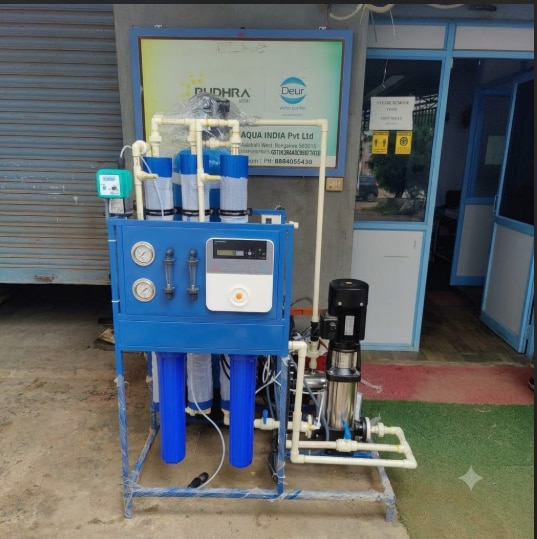 | Packaged Sewage Treatment Plant Packaged Sewage Treatment Plant DAKSHA GREENTECH INTERNATIONAL is a reliable Manufacturer, Supplier, and Trader of Packaged Sewage Treatment Plants, offering compact and efficient... View product → |
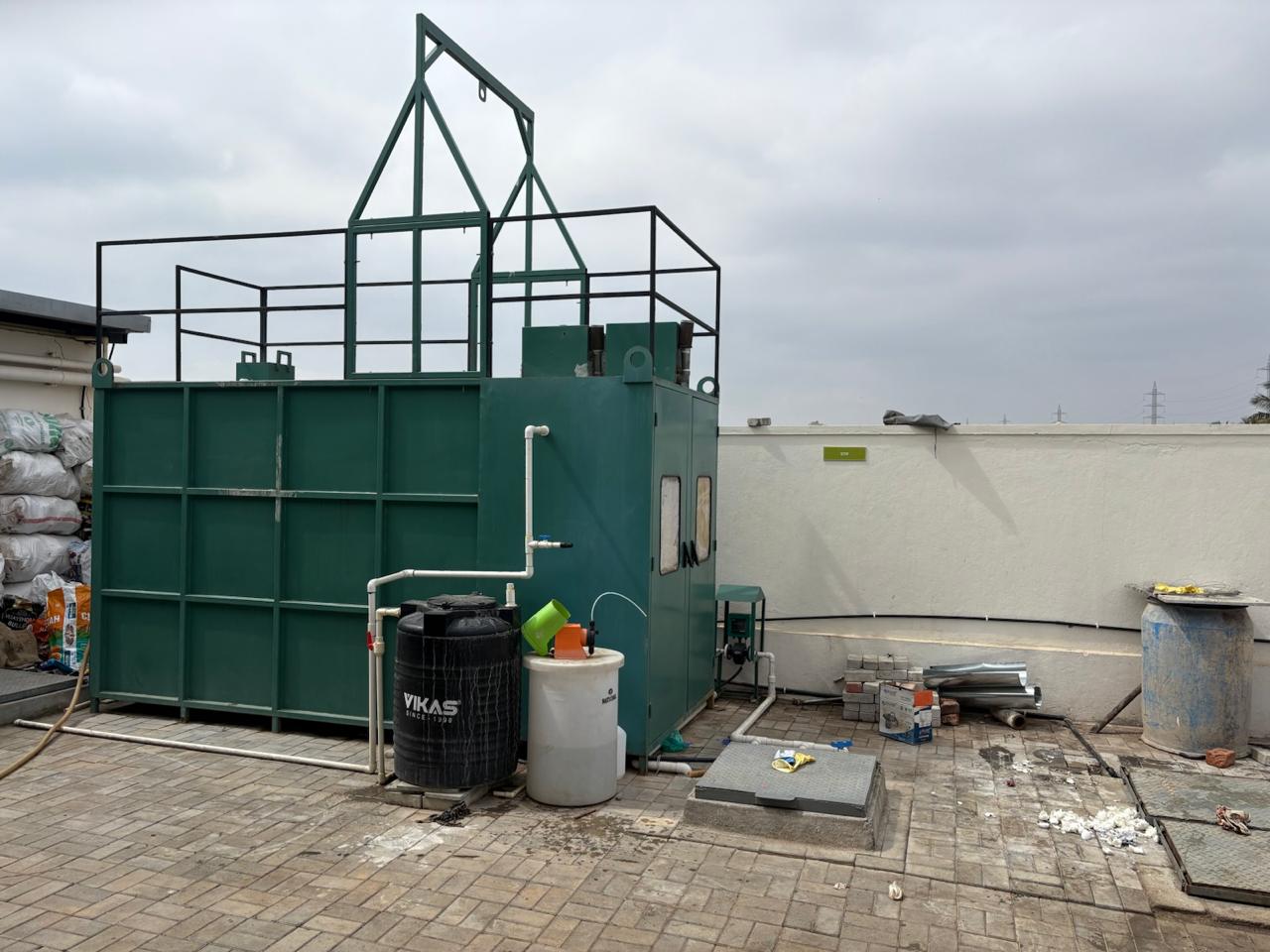 | MBR Sewage Treatment Plant The MBR Sewage Treatment Plant (Membrane Bioreactor) is an advanced wastewater treatment system designed to efficiently treat domestic and municipal... View product → |
Frequently asked questions
How do you calculate STP capacity for a Bengaluru commercial building?
Use measured wastewater flow and peak flow patterns, then compare the result with the building’s occupancy, operating hours and planned expansion. Do not size the plant from the connected water-supply figure alone.
Which packaged STP technology should a commercial building choose?
Compare MBBR, SBR, MBR and activated sludge against footprint, treated-water quality, automation, operator skill, power use, membrane or media maintenance and the intended reuse.
What treated-water quality should the STP achieve?
Set quality targets from the reuse application. Flushing, gardening, cooling-tower makeup and discharge each require different treatment, filtration, disinfection and monitoring provisions.
What should an STP tender and service contract include?
Specify design flow, peak flow, influent assumptions, outlet quality, equipment schedule, civil and electrical scope, testing, commissioning, operator responsibilities, preventive maintenance, spares, sludge handling and response times.
Related products
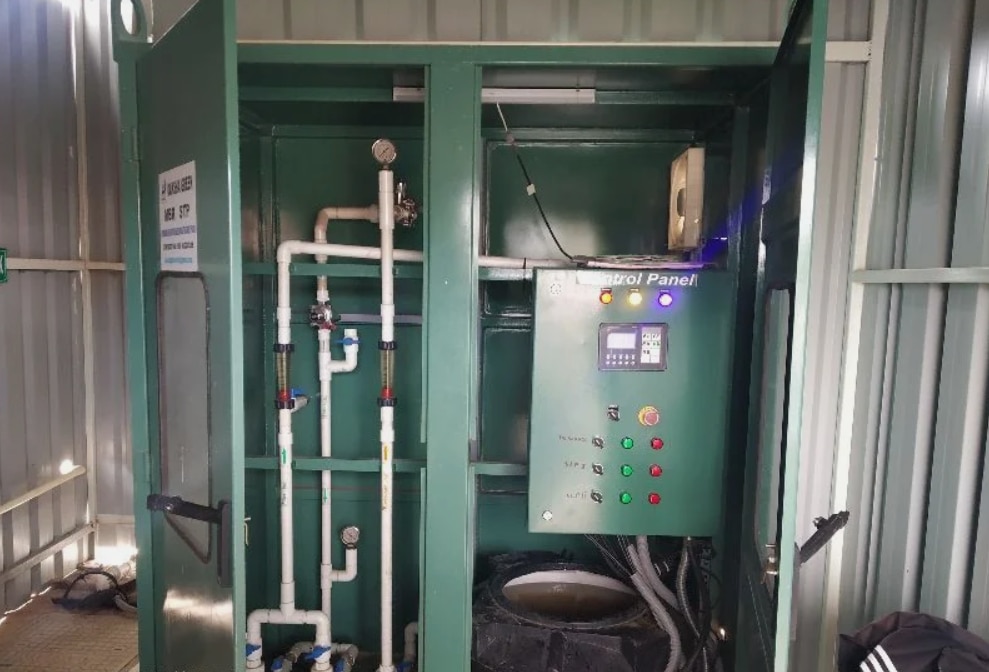 | 25 KLD MBR Sewage Treatment Plant 25 KLD MBR Sewage Treatment Plant DAKSHA GREENTECH INTERNATIONAL offers a highly efficient 25 KLD MBR (Membrane Bioreactor) Sewage Treatment Plant designed to provide advanced and... View product → |
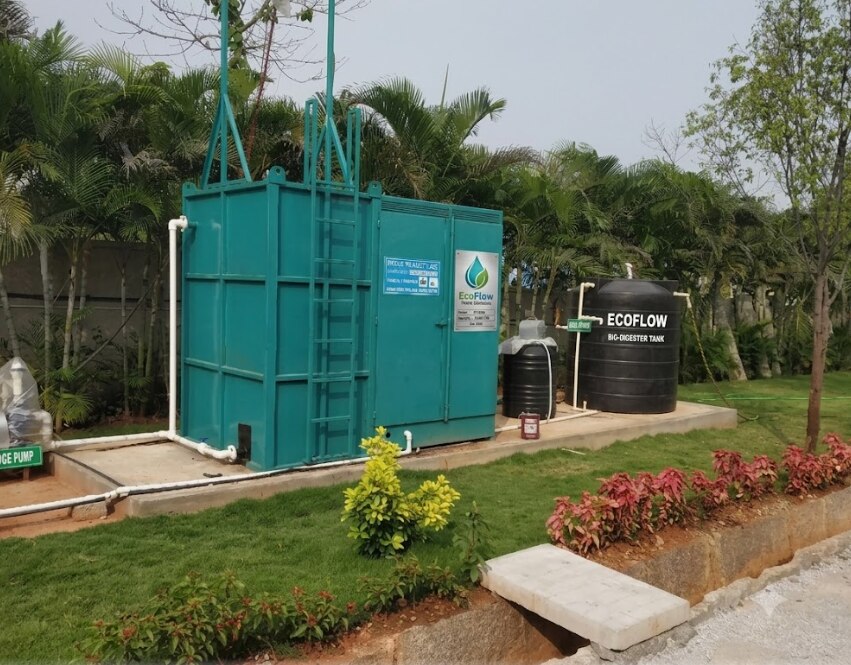 | 10 KLD MBR Sewage Treatment Plant 10 KLD MBR Sewage Treatment Plant DAKSHA GREENTECH INTERNATIONAL is a trusted Manufacturer, Supplier, and Trader of 10 KLD MBR Sewage Treatment Plants, offering advanced and efficient... View product → |
Keywords