An ETP quotation cannot be judged from capacity alone: a 100-KLD plant for one factory may need entirely different chemistry, materials, controls and sludge handling from another. You will be able to prepare a usable design brief, compare Bengaluru suppliers, test the quoted cost and tie payment to measurable treatment performance.
Key takeaways
- Share flow, pH, COD, BOD, TSS and peak-load data before requesting an ETP quote.
- Compare civil works, automation, testing, commissioning and after-sales support—not equipment lists alone.
- Treat ETP price in Bengaluru as capital cost plus power, chemicals, labour and sludge disposal.
- Choose pretreatment and biological or tertiary processes from pollutants and discharge limits.
Give the supplier the wastewater data that determines the design
A credible quotation starts with measured wastewater data, not the plant capacity alone. Give the effluent treatment system supplier the source, variability and required outlet quality; otherwise the price can exclude essential pretreatment or fail during production.
1. State the industry, products, raw materials and chemicals used, including solvents, dyes, oils, acids, alkalis and metal salts. Identify each process stream and keep domestic sewage separate from chemically contaminated effluent.
2. Report average and peak flow in KLD, operating hours, number of shifts, and whether discharge is continuous, intermittent or batch-based. Include equalisation tank details if batches arrive at different times.
3. Provide recent laboratory results for pH, temperature, TSS, TDS, COD, BOD, oil and grease, colour, heavy metals and any process-specific pollutants. Give sample dates and production conditions; submit representative composite samples when the wastewater changes through the day.
4. Define the destination and target quality: discharge to a sewer, surface water or land, or reuse for cooling, flushing or washing. Share the applicable Consent to Establish, Consent to Operate and laboratory limits.
Ask for jar tests, treatability testing or pilot data when the effluent has high salinity, toxicity, solvents, metals, colour, extreme pH or low biodegradability. These conditions can inhibit biological treatment.
The quotation must tie its guarantee to stated influent values, flow, outlet limits, sampling point, test method and commissioning period. Require chemical and power allowances, sludge criteria and remedies for failure; “meets pollution norms” alone is not a usable guarantee.
Compare a Bengaluru supplier beyond the equipment list
Two bids for a 100-KLD plant are not comparable unless they use the same influent, outlet target and scope. Assess an effluent treatment plant supplier in Bengaluru by the evidence behind its promise, not by tank volume or equipment brand.
| Capability | Evidence to request | What it prevents |
|---|---|---|
| Design | Mass balance, process-flow diagram, equipment datasheets and design calculations tied to your test results | An undersized or biologically unstable plant |
| Fabrication | Material grades, weld and leak-test records, factory inspection and corrosion allowance | Early tank, pipe or support failure |
| Installation | Civil-foundation drawings, erection method, cable and piping schedules, commissioning plan | Delays caused by site work being excluded |
| Service | Bengaluru response time, critical-spares list, preventive-maintenance schedule and named technicians | Long shutdowns while parts or expertise are sourced |
Make the quotation identify every included and excluded item: civil foundations, tanks, piping, pumps, electrical panels, automation, online instruments, chemical dosing, sludge dewatering, odour control, freight, erection, commissioning, GST and operator training. A low bid often becomes expensive through these omissions.
Ask the ETP manufacturer in Bengaluru for representative composite-sample results, jar tests or pilot data when wastewater contains solvents, metals, high salinity, colour, toxicity or fluctuating loads. Biology is not a universal remedy.
Daksha Greentech International belongs in the same comparison: require it to state outlet guarantees, sampling methods, operating assumptions, chemical and power limits, and remedies for failure in writing. A promise to “meet pollution norms” is not a usable performance guarantee.
Related products
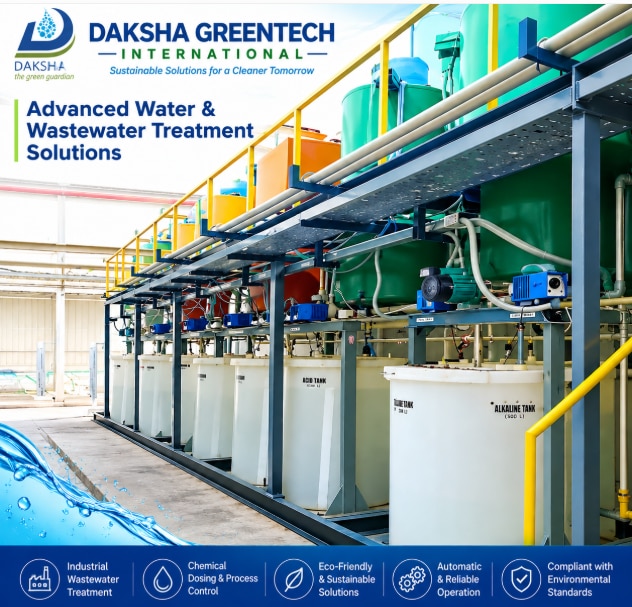 | Effluent Treatment Plant The Effluent Treatment Plant (ETP) is an advanced wastewater treatment solution designed to treat industrial effluents and reduce unwanted... View product → |
 | Industrial Effluent Treatment Plant Industrial Effluent Treatment Plant DAKSHA GREENTECH INTERNATIONAL is a trusted Manufacturer and Supplier of Industrial Effluent Treatment Plants, designed to provide efficient,... View product → |
Read ETP price in Bengaluru as a scope and ownership cost
An early screen for ETP price in Bengaluru is ₹5–12 lakh for a packaged 10-KLD plant, ₹15–35 lakh for 50 KLD, and ₹25–60 lakh for 100 KLD. Treat these as Indian planning ranges, not tender prices: the final effluent treatment plant cost depends on pollutant load, treatment guarantee and site conditions.
| Capacity | Early capital screen | What the range excludes |
|---|---|---|
| 10 KLD | ₹5–12 lakh | Major civil works, difficult pretreatment, tertiary reuse, RO, evaporators, land and taxes |
| 50 KLD | ₹15–35 lakh | The same exclusions; higher chemical, sludge and electrical requirements can also apply |
| 100 KLD | ₹25–60 lakh | The same exclusions; two plants with identical capacity can require very different processes |
A credible quote must state whether it includes civil foundations and tanks, piping, pumps, electrical panels, automation, online instruments, chemical dosing, sludge dewatering, odour control, freight, erection, commissioning, testing, GST and operator training. A low bid often shifts these costs outside the equipment price.
Separate capital cost from ownership cost. Electricity, chemicals, operators, laboratory testing, maintenance, sludge disposal and membrane replacement can dominate spending. RO adds reject management; an evaporator or crystallizer adds heavy thermal-energy demand.
Ask for annual operating assumptions and a five-year replacement schedule. Reject any price based only on KLD: require the influent flow, peak factor, BOD, COD, TSS, oil and grease, pH, TDS, colour, metals, toxicity and required reuse quality to appear in the quotation.
Choose treatment technology from the pollutant, not the catalogue
Choose treatment technology from the pollutant you must remove, because a low equipment price can become a high effluent treatment plant cost when the process cannot handle shock loads or changing chemistry.
| Technology | Choose it when | Main caution |
|---|---|---|
| Physicochemical treatment | pH, suspended solids, metals, colour, or toxic compounds require coagulation, precipitation, or neutralisation | Chemicals and sludge disposal increase operating cost |
| Biological treatment | Biodegradable BOD and COD dominate, with manageable pH, temperature, salinity, and toxicity | Solvents, metals, high TDS, and biocides can inhibit microbes |
| Electrocoagulation | Metals, colour, emulsified oil, or fine colloids resist conventional coagulation | Electricity, electrode replacement, and metal-rich sludge need costing |
| DAF | Oil, grease, fats, fibres, algae, or low-density suspended solids float after chemical conditioning | It is not a substitute for dissolved-COD removal |
| Activated carbon | Residual colour, odour, solvents, or trace organics remain after primary treatment | Media saturates and needs replacement or regeneration |
| Tertiary filtration | Low residual TSS must be removed before reuse, disinfection, or membranes | Filters need backwashing and reliable pretreatment |
| RO or membranes | You need low TDS, demineralised water, or high-quality reuse water | Reject management, fouling, cleaning, and membrane replacement are recurring costs |
Use equalization before biological, membrane, or chemical stages when batch discharge creates peaks in flow, pH, COD, or salinity. Ask for jar tests, respirometry, treatability testing, or a pilot trial when composition varies; a catalogue flow rate cannot prove performance.
Compare power, chemicals, sludge, operator time, laboratory testing, cleaning, and replacement media alongside capital cost. The cheapest quotation often excludes the costs that determine whether the plant remains stable.
Validate the design, compliance route and commissioning guarantee
A defensible proposal ties the ETP to your Karnataka State Pollution Control Board consent conditions, not to a catalogue capacity. Ask the effluent treatment system supplier to map each influent pollutant to a treatment step, state the permitted discharge or reuse point, and identify the sampling location used to prove performance.
Require the offer to specify:
- Influent flow, peak factor, operating hours, pH, temperature, BOD, COD, TSS, oil and grease, TDS, colour, metals and toxic compounds
- Guaranteed outlet values for each consent parameter and each intended reuse application
- Sampling point, commissioning duration, sample preservation and analytical method
- Maximum chemical and power consumption, sludge moisture target and disposal responsibility
- Commissioning acceptance test, operator-training scope and remedy if the outlet fails the guarantee
A credible ETP manufacturer in Bengaluru will request representative composite samples and use jar testing, treatability testing or pilot data when toxicity, salinity, variable batches or low biodegradability could upset biology. “Meets pollution norms” is not a guarantee; it has no measurable limit, test method or remedy.
Confirm the stream boundary before approving the design. An STP treats domestic sewage from toilets, kitchens and bathing areas; a WTP treats raw water for potable or process use. An ETP treats industrial or commercial process effluent.
Keep chemically contaminated wastewater separate from sewage, then verify that the proposed ETP’s treated water matches the consented discharge point or your documented reuse equipment.
Frequently asked questions
What wastewater data should you give an ETP supplier?
Provide the wastewater source, daily average flow, peak hourly flow, operating hours, pH, temperature, BOD, COD, TSS, oil and grease, colour, nutrients, dissolved solids, hazardous contaminants and seasonal variation. State the required outlet quality and whether you will reuse or discharge the treated water.
What should you compare when choosing an effluent treatment plant supplier in Bengaluru?
Compare the process design, included civil and electrical scope, automation, instruments, documentation, performance testing, commissioning support, operator training, warranty, spare-parts access and response time. Ask the supplier to identify every exclusion in the quotation.
What determines ETP price in Bengaluru?
Capacity alone does not determine the effluent treatment plant cost. Price changes with pollutant load, peak flow, pretreatment, biological and tertiary stages, civil works, pumps, controls, sludge handling, site conditions, installation, testing and the required outlet standard. Add recurring power, chemical, labour, maintenance and sludge-disposal costs.
How do you select ETP treatment technology?
Select each process from the pollutant and required outlet quality. Screens and oil traps address solids and oil; equalisation controls variation; biological treatment reduces biodegradable BOD and COD; coagulation, filtration, activated carbon, membranes or specialised processes address specific residual pollutants. Require pilot or treatability evidence when the wastewater is variable or difficult to characterise.
Keywords