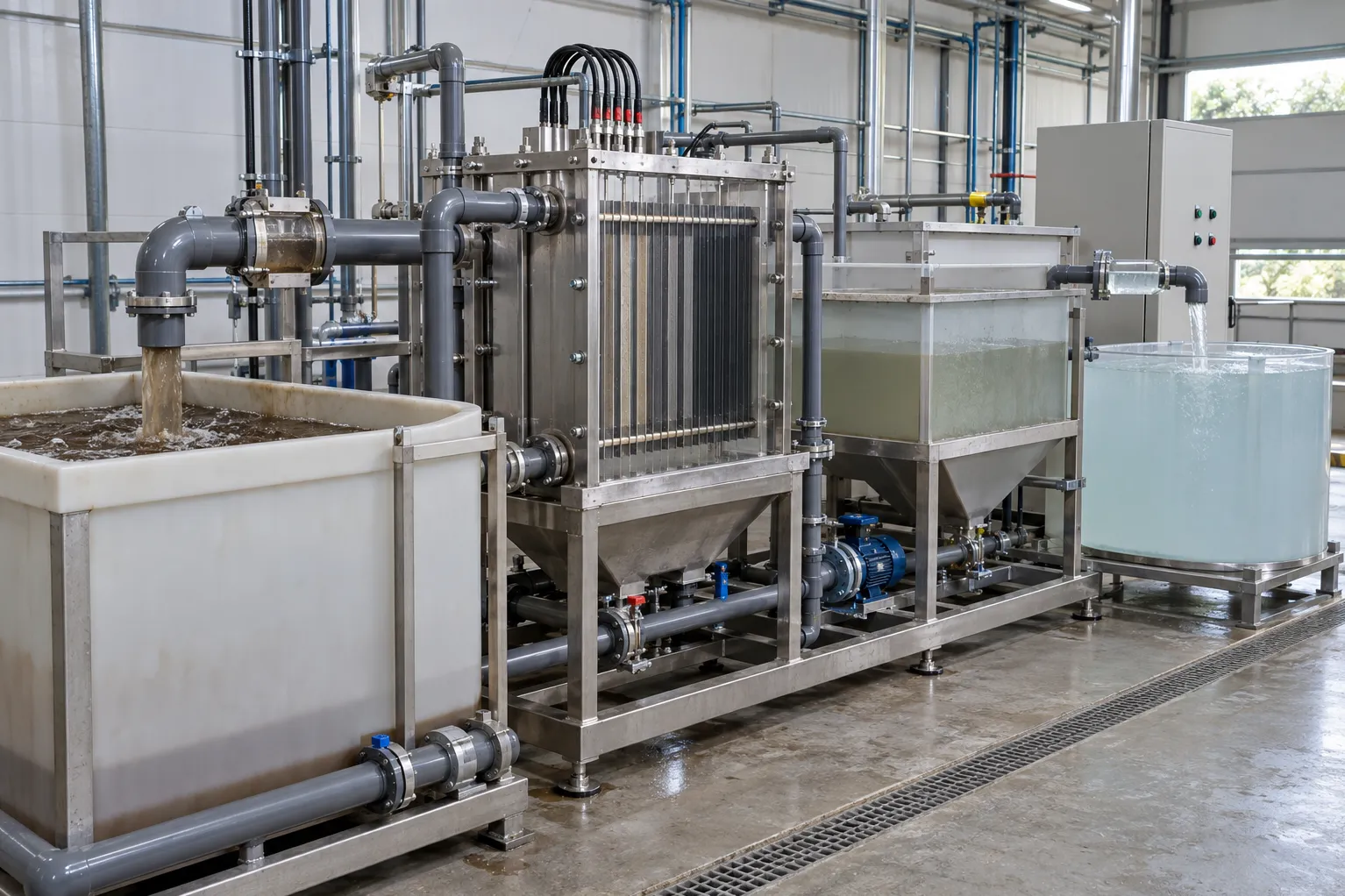
Some wastewater streams contain suspended solids, emulsified oils, colour, metals, or other contaminants that can be difficult to manage through conventional treatment alone. An Electro Coagulation Plant uses electrical current and sacrificial electrodes to support contaminant destabilization and separation.
For industries evaluating alternative treatment processes in Bangalore, electrocoagulation can be worth considering when wastewater characteristics support its use.
How Electrocoagulation Works
In conventional chemical coagulation, chemicals are added to destabilize contaminants so they can aggregate and be separated.
Electrocoagulation generates coagulant species electrochemically from electrodes placed within the treatment system.
As current passes through the reactor, reactions help destabilize certain suspended and dissolved contaminants. The resulting material can then be separated through flotation, settling, filtration, or other downstream processes.
Where Can It Be Useful?
Depending on wastewater composition and treatability, electrocoagulation may be evaluated for streams containing:
- Suspended solids
- Colour
- Oil and grease
- Emulsified contaminants
- Certain metals
- Selected industrial pollutants
Performance varies considerably according to wastewater chemistry.
This makes treatability testing particularly important.
Questions to Ask Before Buying
An organization considering electrocoagulation should understand:
- Which contaminants need removal?
- What removal efficiency has testing demonstrated?
- How quickly are electrodes consumed?
- What electrical load is expected?
- How much sludge will be generated?
- What pretreatment is necessary?
- What downstream treatment is required?
- How frequently must electrodes be cleaned or replaced?
Without these answers, comparing systems only by flow capacity provides an incomplete picture.
Electrode Consumption Affects Operating Cost
Electrodes are consumable components.
Their material, surface condition, current density, wastewater chemistry, and operating time can influence consumption.
Power consumption and sludge management also contribute to lifecycle cost.
A realistic evaluation should therefore compare total treatment cost rather than only equipment price.
Pilot Testing Can Reduce Uncertainty
Industrial effluent varies widely.
Testing a representative wastewater sample can help establish whether electrocoagulation provides meaningful removal of the target contaminants before a full-scale system is finalized.
Daksha Greentech can evaluate wastewater characteristics and treatment objectives when developing solutions for industrial users in Bangalore.
Select Technology According to the Effluent
Electrocoagulation should not be treated as a universal replacement for biological, chemical, or membrane treatment.
In some applications, it may serve as pretreatment. In others, it may be integrated with clarification, filtration, biological treatment, or membranes.
The strongest reason to select an Electro Coagulation Plant is demonstrated compatibility with the actual wastewater. When treatability, electrode consumption, sludge production, energy use, and downstream requirements are evaluated together, organizations can make a far more informed investment decision.
Keywords